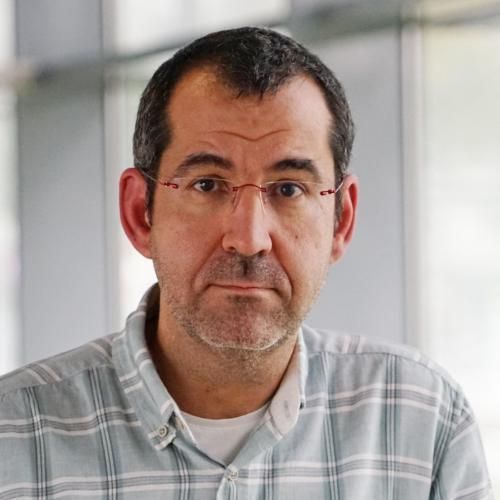
ANXO
VIDAL FIGUEROA
Profesor contratado doutor
Institut: Departamento de Fisioloxía
Fakultät: Facultade de Medicina e Odontoloxía
Einzigartiges Zentrum: Centro de Investigación en Medicina Molecular e Enfermidades Crónicas (CIMUS)
Bereich: Physiologie
Forschungsgruppe: Mecanismos moleculares da enfermedade
Email: anxo.vidal@usc.es
Persönliche Website: https://cimus.usc.gal/staff/anxo-vidal-figueroa


Doktor von der Universidade de Santiago de Compostela mit der Dissertation Análisis funcional de protimosina alfa en cultivos celulares 1997. unter der Leitung von Dr. Fernando Domínguez Puente, Dr. M. Clara Alvarez Villamarin.
Anxo Vidal received his Ph.D. in Cell Biology in 1997 at the University of Santiago de Compostela. From 1998 to 2003 he was a postdoc at Memorial Sloan-Kettering Cancer Center. Anxo’s research interests were the study of p27Kip1 regulation and the genetic and functional relationships among tumor suppressors. In 2002 he was ranked no. 2 nationwide in the area of Physiology in the “Ramon y Cajal” Program. Back in Santiago de Compostela in 2003, he established his own laboratory devoted to study cell cycle and tumor biology through mouse models. Since 2008, Anxo is an Associate Professor of Physiology in the University of Santiago de Compostela. Anxo was the recipient of the 2006 Novartis Award in Endocrine Tumor Pathology. Invited speaker at several national and foreign research centers. Principal investigator of competitive national and international grants, he is an author of more than 60 international publications in high visibility journals (Nature Communications, Cell Stem Cell, Nature Neuroscience, Adv Func Mater…), with an h-index of 31(Scopus, september 2024) and a relative citation ratio of 1,43 (iCite, september 2024). He is an author also of four international patents and has supervised 15 PhD thesis. Main contributions to research are summarized as follows: 1. Mechanisms of p27Kip1 translational regulation: During my postdoctoral stage at MSKCC my research focused on how levels of p27Kip1 are regulated. I was involved in the characterization of 'cis' elements on p27 mRNA important for its translation, the isolation of proteins that bind those sites as well as the delineation of signalling pathways involved (Millard et al MCB 2000; Vidal et al JBC 2002). 2. New cooperative functions of cell cycle regulators: In contrast to biochemical and cellular approaches, genetic tools have provided light to overlapping and redundant “in vivo” roles of cell cycle inhibitors. Using genetically modified mouse models my work has contributed to discover new cooperative functions of cell cycle regulators in angiogenesis (Vidal et al, PNAS 2005) and endochondral bone formation (Yeh et al, MCB 2007). 3. Cell cycle independent roles of cdk-inhibitors in stem cell biology: For many years the only attributed functions of cdk inhibitors (mainly p21Cip and p27Kip1) were to bind to and to inhibit cdk kinases. In collaboration with others my group has made important contributions to show how these inhibitors work as transcriptional regulators, a function which is essential for stem cell biology, and for their role as tumor suppressors (Li et al Cell Stem Cell 2012; Marques-Torrejon et al Cell Stem Cell 2013; Porlan et al Nat Neurosci 2013). 4. The molecular relationship between reprogramming, transformation, and aging: In continuation with previous findings, our group has contributed to establish how cell cycle regulators control expression of reprogramming factors, and how this impinges on tumor initiation and development, in tissue homeostasis maintenance and in aging (Vilas et al Oncotarget 2015; Vilas et al Aging Cell 2018; Ferreiros et al Stem Cell Reports 2019). 5. New therapeutic tools in advanced cancer: In recent years, our group has begun to explore new therapeutic strategies in cancer using nanomedicines (Amaral et al Angew Chem 2018; Teijeiro-Valiño et al J Control Rel 2019; Goldberg et al Nature Commun 2022). Work from my lab has contributed to establish that drug nanocarriers represent a promising therapy for the treatment of advanced lung metastatic cancer (Borrajo et al J Control Rel 2016) and to test atomic clusters as therapeutic tools in advanced cancer (Porto et al Adv Func Mater 2022). We are currently exploring innovative therapies through immunotherapy (Retos Colaboración grant with SunRock Biopharma and two current grants for immunotherapy against ovarian cancer).